
Parts of orthodontic braces. Braces are an orthodontic treatment that fixes mouth issues like underbites, overbites, jaw disorders, incorrect jaw alignment, and crowded teeth. They are typically recommended for children between the age of 10 and 14 because their mouths are still growing, which facilitates the teeth straightening. Today, there is a growing trend in adults receiving braces treatment to fix minor cosmetic issues and enhance their smiles. In this post, we’ll show you all the different parts of braces and of course what they do. Let’s get cracking.
People also ask
- What parts of braces is the bracket?
- What is an orthodontic button?
- What do metal bands do for braces?
- Do the metal bands for braces hurt?
Types of Orthodontic Treatments
There are several styles and types of treatment options available, including:
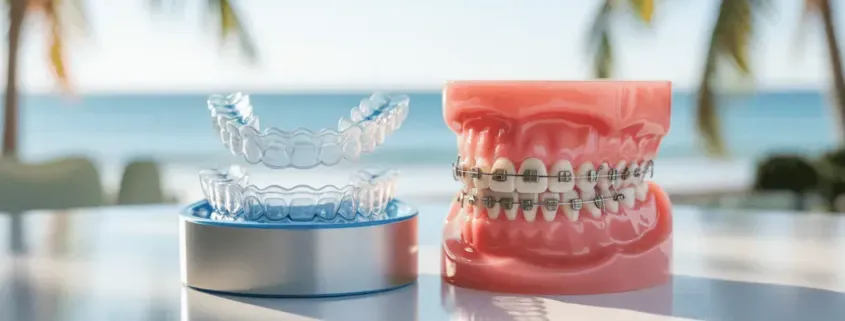
- Metal/Traditional. This style is the most noticeable; however, it is the least expensive and is available in several different colors.
- Ceramic. This style is similar to the traditional style but is clear in color to help them blend in with the teeth. Ceramic is usually more expensive than the traditional option and requires more maintenance to avoid staining.
- Lingual. This style is the same as the traditional, except for its placement. Your dentist will place these along the inside of the teeth. The lingual style is invisible but is also more expensive, difficult to maintain, and harder to adjust than traditional ones.
- Invisalign. This style uses clear, removable, and customized aligners to straighten your teeth in small steps. Advanced 3-D graphics technology precisely designs and develops your aligner to fit your mouth for each stage. You take the aligner out to eat and brush your teeth and receive a new one every two weeks to gradually straighten your teeth.
Parts of Braces
Treatments consist of several parts. You can follow your care plan by understanding these parts of braces and their functions.
-
Archwires and Bands
The archwire is a stainless steel support system that helps shift your teeth. Successful tooth movement requires the archwire in place. These metal wires are bent to fit into the needs of your mouth. As the teeth shift, your orthodontist bends and tightens the wires, which increases pressure and helps guide your teeth into their new positions.
The bands are ceramic or traditional stainless steel rings set around the molars. Your orthodontist uses special equipment to custom fit the bands to your teeth. Metal attachments on the side of the band allow the archwire to pass through them. Dental cement binds the bands to your molars.
-
Separators (Spacers)
Separators are small rubber bands that help create space between your molar before installing your device. Your orthodontist will place spacers between molars that need metal bands. The teeth are generally fit compactly next to each other. Separators are worn for about a week to slightly push the teeth apart so that the thick bands can fit around the molars.
-
Bite Ramp
Bite ramps are small plastic blocks that attach to the back of your teeth to open a deep bite. The ramps keep you from biting and damaging your hardwiring. Your orthodontist will remove the bite ramps once your bite develops.
-
Brackets
Traditional style treatments use a square-shaped bracket that attaches to the band or chemically connects to the surface of the tooth. They each have a slot to hold and support the archwire. Some have small metal hooks for elastic bands. These pieces are available in several styles, including ceramic, traditional metal, and shapes.
-
Ligatures
Ligatures are tiny bands that hold the archwire to the square-shaped structures on the teeth and are the best part of treatment for adolescents. Ligatures come in a variety of colors, and patients can choose different color combinations each adjustment. Your orthodontist will replace the ligatures during each appointment.
-
Elastics (Rubber) Bands
Your orthodontist may hook small elastic bands (Intermaxillary elastics) to connect the upper and lower parts of your teeth during treatment. The rubber bands apply pressure on your teeth to facilitate movement and gradually fix your bite.
For example, if you have an overbite, your orthodontist will hook the elastic bands from the top front teeth to the bottom back teeth. This method fixes your bite by gradually forcing the jaw back to its correct position.
-
Palatal Expander
A palatal expander is a device that helps make the upper arch wider. Your orthodontist may use this appliance if you have a cross-bite of the back teeth.

-
Herbst Appliance
The Herbst Appliance is an orthopedic appliance that modifies the growth of the jaw. Your orthodontist cements this device into place. It functions by keeping the lower jaw in a forward position to support the potential for maximum lower jaw growth. Despite your jaw’s forward position, the device does not constrict your ability to open, close, and move your mouth around as normal.
-
Coil Springs and Power Chains
If two of your teeth are too close together, your orthodontist will use a coil spring over the archwire to shift the teeth away from each other. The coil is put over the archwire and exerts pressure to separate the teeth and free up space.
If you have slight spaces between your teeth, your orthodontist will use a power chain to help close the space. Power chains are links of rings that create a continuous band between the teeth. They also inhibit gaps from developing between your teeth. Your orthodontist replaces power chains during each visit.
-
Retainers
Retainers are a critical part of having a successful orthodontic treatment. They hold the teeth in place after your orthodontist removes your device. Teeth contain fibers that help them connect to the bone. These fibers stretch during your treatment and will want to pull teeth back to their original position.
Retainers prevent this from happening by giving the fibers time to adjust in their new position. The longer you wear a retainer, the less likely your teeth will shift or become crooked again.
-
Bonded (Fixed) Retainer
Bonded retainers are connected to the inside of the teeth to keep them straight after you remove your device. They are sometimes used behind the upper front teeth to help keep gaps closed.
Conclusion
Have you been considering treatment? Call to schedule a consultation with us today! We know everything to do with oral health and all the parts of braces. Dr. Panucci will meet with you to discuss correcting your smile.
- Which tip will you try first???
- Either way, let us know by leaving a comment below right now and continue the conversation. Also, link in Twitter over @DrPattiPanucci


220 N. Aviation Blvd. Suite A
Manhattan Beach, CA 90266
Phone: (310) 379-0006
Parts of Braces Explained Fully | 2020 | STEP-BY-STEP GUIDE

Dr Patti Panucci attended the University of Louisville School of Dentistry for four years, where she graduated with a DMD degree (May 2000) among the Top 10 in her class. Following that, she headed west to Los Angeles to complete her three-year residency at one of the top-ranked orthodontic programs in the country – the University of Southern California.
Along with her certificate in orthodontics, Dr. Panucci earned a master’s degree in craniofacial biology. During those three years, she fell in love with Southern California beach life and decided that this was where her future lay.