
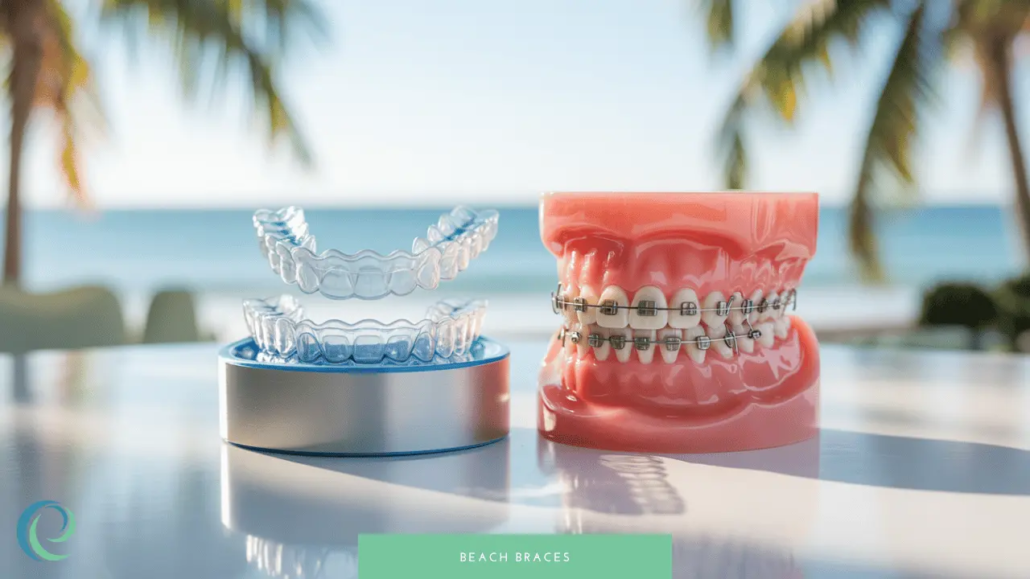
Invisalign vs Braces in Manhattan Beach, How to Choose Based on Your Smile
Invisalign vs braces in Manhattan Beach is one of the most common decisions patients and parents face when they start thinking about orthodontic treatment. Both options can straighten teeth, improve bite alignment, and help create a healthier smile, but they do not work the same way, and they are not equally suited to every patient.
At Beach Braces, Dr. Patricia Panucci offers Invisalign, Invisalign Teen, ceramic braces, self-ligating braces, and other orthodontic options for children, teens, and adults across Manhattan Beach and the South Bay. The real goal is not to push one treatment over another. It is to understand your smile, your bite, your lifestyle, and your treatment goals before recommending the option that makes the most sense.
If you are trying to decide between Invisalign in Manhattan Beach and braces, this guide will help you understand the main differences, the lifestyle factors to consider, and what your consultation can help clarify.
Invisalign vs Braces: The Simple Difference
Invisalign uses a series of clear, removable aligners to gradually move your teeth. The aligners are custom-made for your mouth and are changed in stages as your teeth move. Invisalign is popular with adults and teens because it is discreet, removable, and easier to fit around meals, brushing, and flossing.
Braces use brackets and wires that stay fixed to the teeth throughout treatment. At Beach Braces, treatment options include esthetic clear braces, self-ligating metal braces, and WildSmiles brackets for younger patients. Fixed braces can be especially helpful when the orthodontist needs more control over tooth movement or when patient compliance may be a concern.
The American Association of Orthodontists explains that clear aligners may be used for issues such as crowded teeth, gaps, overbites, underbites, open bites, and crossbites. However, the best way to decide which treatment is suitable is to be assessed by an orthodontist. Read the AAO guide to clear aligners.
Some patients come in certain they want Invisalign, while others assume they need braces. The consultation helps us look beyond appearance and choose the option that best fits the teeth, bite, and lifestyle.
Why the Right Choice Starts With Diagnosis
Many patients arrive already leaning toward one option.
Adults often like the idea of Invisalign because it feels subtle and flexible. Teens may want clear aligners because they worry about how braces will look at school, during sports, or in photos. Parents may prefer braces because they stay in place and do not rely on a child remembering to wear aligners for most of the day.
All of those concerns are valid. But the best treatment choice starts with a proper diagnosis.
Beach Braces highlights that treatment plans are personally customized by Dr. Panucci based on each patient’s individual needs. The practice also uses advanced technology, including advanced 3D imaging, to help assess teeth, jaws, bite, and airway before treatment planning.
During your consultation, Dr. Panucci may look at:
- How crowded or spaced your teeth are
- How your upper and lower teeth fit together
- Whether there are bite issues such as overbite, underbite, open bite, or crossbite
- Whether root position or jaw relationship affects treatment planning
- Whether Invisalign can achieve the needed movement predictably
- Whether braces would give better control
- Whether a shorter touch-up option may be suitable
- Whether treatment should start now or be monitored
That is why the real question is not, “Which is better, Invisalign or braces?” A better question is, “Which is better for this smile?”
When Invisalign May Be a Good Fit
Invisalign may be a strong option if you want a discreet treatment that fits around a busy lifestyle.
Because the aligners are clear, many people find them easier to wear at work, school, social events, and everyday activities. They can also be removed for eating, brushing, and flossing, which many patients find convenient.
Invisalign may be worth discussing if you have:
- Mild to moderate crowding
- Gaps between teeth
- Previous orthodontic treatment with minor shifting
- Bite issues that can be managed with aligners
- A strong preference for a less visible treatment
- Good habits and the ability to wear aligners as instructed
- A schedule where removable treatment would be helpful
For adults who only need a subtle improvement, Beach Braces also offers Smile Refresh, a clear aligner touch-up option designed for mild crowding, spacing, or shifting. The page notes that Smile Refresh may be suitable for adults who want minimal aligners, faster results, and final retainers to help protect the new smile.
When Braces May Be a Better Choice
Braces may be a better fit when fixed treatment gives the orthodontist more consistent control.
Because braces stay attached to the teeth, they do not depend on the patient remembering to put them back in after meals. That can make them a practical option for children, teens, or adults who prefer not to manage removable trays.
Braces may be recommended if:
- Tooth movement is more complex
- The bite needs more detailed correction
- Teeth need rotation or vertical movement
- The patient may not wear aligners consistently
- A child or teen is not ready for the responsibility of removable aligners
- The orthodontist feels fixed treatment offers better control
- The patient wants a reliable treatment that stays in place
Beach Braces offers several braces options, including ceramic braces in Manhattan Beach, which can be a useful middle ground for patients who want fixed treatment with a less noticeable look. The ceramic braces page explains that they work much like traditional braces, but the brackets are designed to blend better with the natural color of the teeth.
Local Note: Manhattan Beach Lifestyle Matters
For patients in Manhattan Beach, treatment has to fit real life.
Teens may be balancing school, sports, beach days, music, photos, and social events. Adults may be juggling work, commuting, parenting, meetings, and travel. Parents may be looking for something predictable, manageable, and easy to keep on track.
That is why lifestyle is part of the decision.
Invisalign can work very well for responsible teens and adults who will wear their aligners consistently. Braces can work better for patients who want treatment that stays in place all day and night. Ceramic braces may appeal to patients who want fixed treatment but still care about appearance.
Beach Braces serves families throughout Manhattan Beach and surrounding South Bay communities, including Hermosa Beach, Redondo Beach, El Segundo, Torrance, and Hawthorne. The practice is located at 220 N Aviation Blvd, Suite A, Manhattan Beach, CA 90266.
What We Often See in Practice
Patients and parents usually want a clear answer quickly. That is understandable, but the right answer often depends on a few practical details.
Common questions include:
- “Can I get Invisalign instead of braces?”
- “Will braces work faster?”
- “Will Invisalign work for my bite?”
- “Is my teen responsible enough for aligners?”
- “Are clear braces a good middle ground?”
- “Will my child need treatment now or later?”
- “Can I fix shifting teeth without full treatment?”
- “How much will Invisalign cost compared with braces?”
What often surprises patients is that the choice is not only about appearance. It is also about control, consistency, bite correction, oral hygiene, treatment goals, and daily habits.
A patient who wants Invisalign may still be better served by braces if the movements are more complex. Another patient who assumes they need braces may be a good candidate for Invisalign. A parent who worries their teen will not wear aligners may feel more confident choosing fixed braces. An adult with minor shifting may not need full treatment and may be able to explore a touch-up option like Smile Refresh.
The consultation helps separate assumptions from reality.
Invisalign vs Braces for Teens
For teens, the choice often comes down to responsibility, lifestyle, and the type of tooth movement needed.
Invisalign Teen can be appealing because it is clear and removable. It may suit teens who are motivated, organized, and willing to wear their aligners as directed. Beach Braces notes that Invisalign Teen includes features designed for younger patients, including wear indicators and replacement aligners for the occasional lost tray.
Braces may suit teens who would rather not manage removable trays or who need a treatment option that is working full-time. Braces can also be customized with colors or bracket styles, which some younger patients actually enjoy.
For active teens in Manhattan Beach, sports can also affect the conversation. If a teen plays contact sports, the orthodontist can discuss mouthguard use, comfort, and how each option fits their routine.
The best teen treatment is the one that matches both the clinical need and the teen’s real habits.
Invisalign vs Braces for Adults
Adults often approach treatment differently from teens.
Many adult patients want something discreet. They may have client meetings, professional responsibilities, family events, or social plans where they would prefer a less visible option. Invisalign or ceramic braces can both be good choices, depending on the case.
Adult patients may also have factors that need closer review, such as:
- Teeth that shifted after past braces
- Worn teeth
- Previous dental work
- Gum health considerations
- Bite changes over time
- Missing teeth or planned restorative work
- A desire for a limited smile touch-up
The FDA notes that aligners are clear plastic trays worn over the teeth to straighten them, and that patients usually receive a series of custom-made aligners worn in stages as directed by the dentist or orthodontist. Read the FDA consumer update on braces and aligners.
For adults in Manhattan Beach, the best choice often comes down to the complexity of the case, visibility preferences, treatment goals, and whether the patient can follow the daily wear routine required for aligners.
Invisalign vs Braces for Oral Hygiene
Oral hygiene is another important factor.
With Invisalign, aligners are removed for brushing and flossing. This can make daily cleaning simpler, as long as the patient also keeps the aligners clean and remembers to put them back in.
With braces, brackets and wires stay in place. That means brushing and flossing take more care. Patients need to clean around the brackets, wires, and gumline properly to reduce the risk of plaque buildup.
Neither option is “easy mode.” Invisalign requires discipline. Braces require careful cleaning.
The right choice depends on what the patient is most likely to manage well.
Invisalign vs Braces for Food and Daily Routine
Food is one of the biggest practical differences.
With Invisalign, you remove the aligners before eating. That means you can usually continue eating your normal foods, but you need to brush before putting the aligners back in. You also need to avoid leaving them out for too long.
With braces, you do not remove anything at meals. However, you may need to avoid hard, sticky, or chewy foods that could damage brackets or wires.
For some patients, Invisalign feels more convenient. For others, braces are easier because there is nothing to remove, misplace, or remember.
If you are a busy adult, frequent snacker, athlete, musician, or parent choosing treatment for a child, this is worth discussing during your first consultation.
Invisalign vs Braces for Treatment Time
Treatment time depends on the complexity of the case, not just the appliance.
Some Invisalign cases are shorter. Some braces cases are shorter. Some patients need comprehensive treatment either way. Others only need limited movement.
Beach Braces notes that Invisalign treatment may use as few as 12 aligners or as many as 48, with each aligner typically worn for about two weeks before switching to the next. The same page also explains that the first step is visiting the office to determine if Invisalign is right for you.
This is why it is risky to compare treatment time without an exam. A proper consultation can help you understand whether your case is simple, moderate, or complex, and whether Invisalign or braces is likely to be more efficient for your goals.
Invisalign vs Braces for Cost
Cost is one of the first questions most patients ask, and rightly so.
At Beach Braces, Invisalign is described as comparably priced to traditional braces for most cases, usually depending on complexity. The practice also notes that PPO insurance benefits may apply to Invisalign, and flexible payment plans are available.
The important point is that cost is usually tied to the complexity of treatment, not simply whether you choose Invisalign or braces.
A mild touch-up may cost less than comprehensive treatment. A complex bite correction may cost more because it requires more planning, time, and follow-up. That is why a consultation is the best way to get a realistic answer.
You can also review Beach Braces’ information about affordability, insurance, and interest-free financing on the Beach Braces homepage.
Is One Option Better Than the Other?
No. Invisalign is not automatically better than braces. Braces are not automatically better than Invisalign.
The American Association of Orthodontists explains that one appliance is not inherently better than another. The right treatment depends on the patient’s correction goals and lifestyle needs. Read the AAO comparison of braces vs clear aligners.
That is the most honest answer.
Invisalign may be better for one patient because it fits their lifestyle and can handle the needed tooth movement. Braces may be better for another because the case needs more control or the patient does not want to manage removable aligners.
A good orthodontic recommendation should be personal, not generic.

Braces and Invisalign can both create beautiful results. The most important step is understanding what your smile needs before choosing the appliance.
Questions to Ask During Your Consultation
If you are comparing Invisalign and braces, bring your real concerns to the consultation. The more honest you are about your lifestyle and habits, the better the recommendation will be.
Helpful questions include:
- Am I a good candidate for Invisalign?
- Would braces give better control in my case?
- Is my bite simple or complex?
- How long is treatment likely to take?
- Will I need attachments, elastics, or other appliances?
- How often will I need appointments?
- What happens if I do not wear aligners enough?
- Are ceramic braces a good option for me?
- Is Smile Refresh enough, or do I need full treatment?
- What will retainers look like after treatment?
You can learn more about what to expect by visiting the Beach Braces page for your first consultation.
Frequently Asked Questions About Invisalign vs Braces in Manhattan Beach
Is Invisalign better than braces?
Invisalign is better for some patients, but not all. It may be ideal for people who want a discreet, removable option and can wear their aligners consistently. Braces may be better for more complex movements or for patients who prefer fixed treatment.
Do braces work faster than Invisalign?
Not always. Treatment time depends on the complexity of your case, your bite, your goals, and how well treatment is followed. Some Invisalign cases are quick, while some braces cases are quick. A consultation gives the clearest estimate.
Is Invisalign good for teens?
Invisalign Teen can be a good option for responsible teens who will wear their aligners as instructed. Braces may be a better choice if a teen is likely to lose aligners or forget to wear them enough each day.
Are ceramic braces better than Invisalign?
Ceramic braces are not necessarily better, but they can be a smart option for patients who want fixed treatment with a less noticeable look. They may suit patients who like the appearance of clear treatment but need or prefer braces.
Can Invisalign fix bite problems?
Invisalign can help with some bite issues, but not every bite problem is best treated with aligners. Your orthodontist will assess your teeth, jaws, and bite before recommending Invisalign or braces.
How do I know which option is right for me?
The best way to know is to schedule a consultation with an orthodontist. At Beach Braces, Dr. Panucci can assess your smile, bite, goals, and lifestyle before explaining whether Invisalign, braces, ceramic braces, or another option is most suitable.
Final Thoughts: Choose the Treatment That Fits Your Smile
Choosing between Invisalign and braces in Manhattan Beach should not feel like guesswork.
Invisalign may be a great fit if you want a discreet, removable option and are ready to follow the wear schedule. Braces may be the better choice if you need more controlled movement, want treatment that stays in place, or prefer not to manage removable aligners. Ceramic braces can offer a useful middle ground for patients who want fixed treatment with a more subtle appearance.
The right answer depends on your smile, your bite, your habits, and your goals.
At Beach Braces, Dr. Panucci can help you compare your options clearly, without pressure. Whether you are considering Invisalign, braces, ceramic braces, or a smaller touch-up with Smile Refresh, the first step is understanding what your smile actually needs.
Ready to Compare Invisalign and Braces?
If you are deciding between Invisalign and braces in Manhattan Beach, schedule a personalized consultation with Beach Braces.
Dr. Panucci and the team will help you understand your options, compare treatment choices, and choose the path that makes the most sense for your smile, lifestyle, and long-term result.
Schedule your consultation with Beach Braces
Invisalign vs Braces in Manhattan Beach, How to Choose Based on Your Smile


Leave a Reply
Want to join the discussion?Feel free to contribute!